







Dali's Perpetual Waterfall
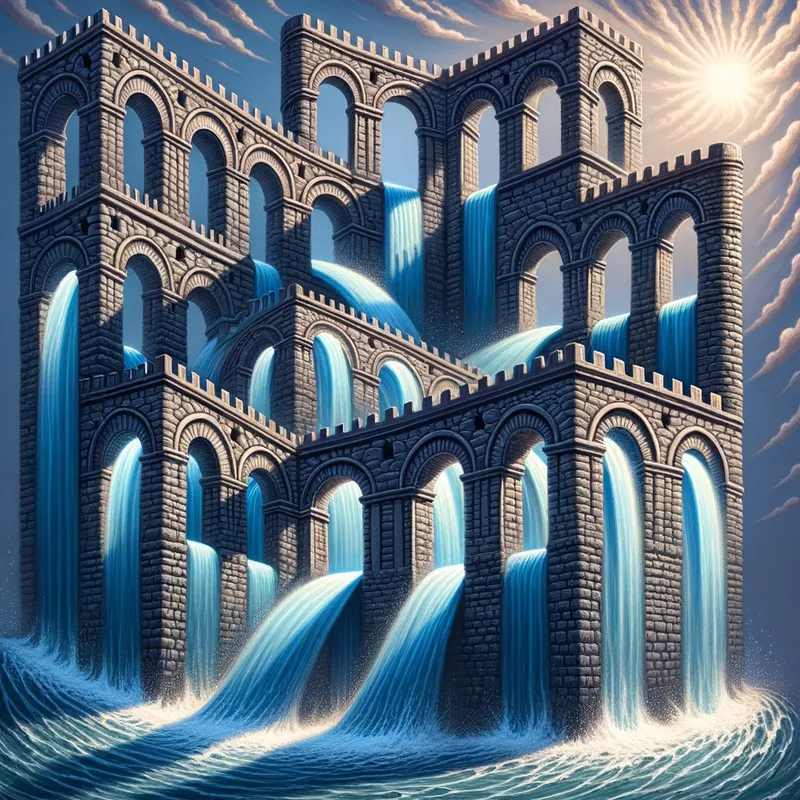
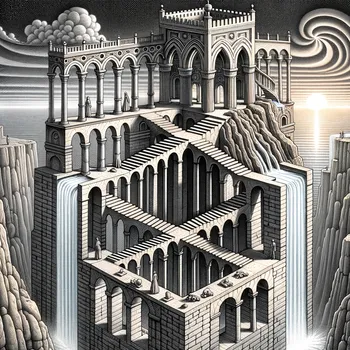
create an illusion inspired by M.C. Escher’s “Waterfall” (1961) with a Salvador Dali twist. Imagine a scene where water defies gravity, flowing endlessly through a series of castle towers. Here’s a description of the surreal composition: Starting Point “X”: At the base of the image, we have a mysterious point labeled “X.” This is where our magical water journey begins. Three Medium-Height Castle Towers: Tower A: To the left of “X,” we see a medium-height castle tower. The water flows upward, defying physics, and enters an arched opening. Tower B: Adjacent to Tower A, we have another tower. The water continues its ascent, making a 90-degree right turn. Tower C: Tower C stands to the right of “X.” The water defies logic, turning left at a right angle once more. Perpetual Water Movement: The water flows seamlessly from Tower A to Tower B, then from Tower B to Tower C. It’s as if gravity has taken a vacation! Finally, the water reaches the top of Tower C, where it cascades down like a waterfall. But wait! Instead of falling to the ground, the water loops back to the base, returning to our mysterious starting point “X.” Optical Illusion: The towers are intricately detailed, with stone textures, windows, and battlements. Shadows play tricks on our eyes, making it seem like the water is perpetually climbing. Salvador Dali’s Touch: Dali’s surrealism infuses the scene with dreamlike qualities. Perhaps the towers twist and warp, their proportions bending like melting clocks. The water itself might shimmer with iridescent colors, defying reality. Remember, this is an illusion—an impossible feat of architecture and physics. But in our surreal world, anything goes!