Dress Code Dystopia - AI Generated Image with Photorealistic 2

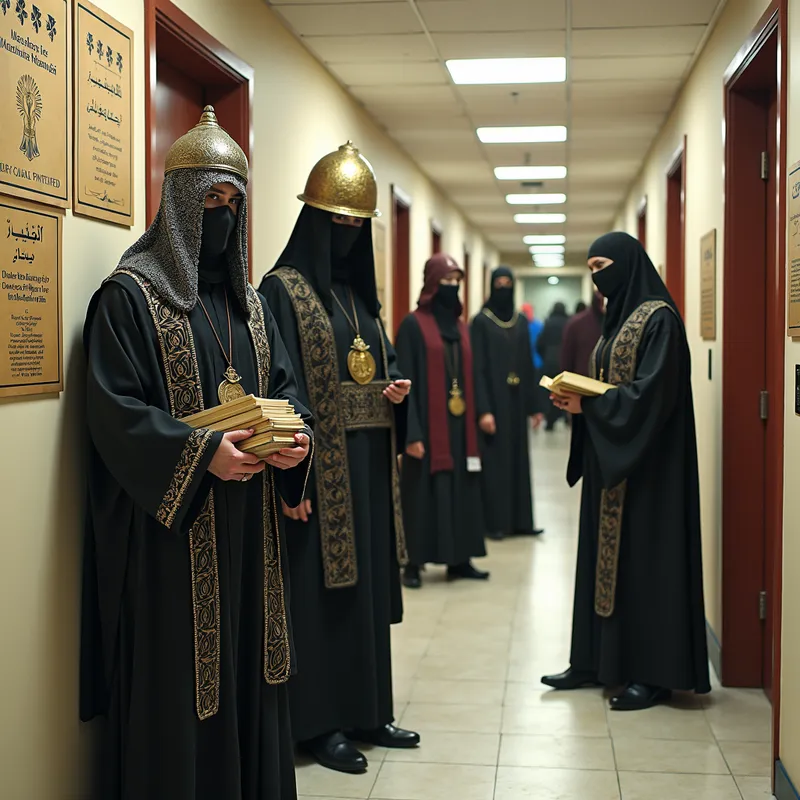
Dress Code Dystopia - Imagine a university announcement poster, styled with an official and somewhat outdated aesthetic, bearing the title: "لباس رسمی جدید دانشگاه: بازگشت به قرون وسطی!" ("New University Dress Code: A Return to the Dark Ages!").  Visual Elements: Students in Traditional Yet Over-the-Top Uniforms:  Male students in exaggerated, chainmail-inspired cloaks with helmets resembling medieval armor, but adorned with a decorative, overly Islamic pattern to mock an “authentic” style. They look burdened, with one student struggling to hold a stack of books under the weight of his “uniform.” Female students in floor-length chadors or elaborate black hijabs with oversized veils, covering nearly everything but their eyes. They are also draped in embroidered cloaks or capes with humorous “feminine” insignias in elaborate calligraphy, symbolizing “purity” or “propriety.” Both groups wear sashes labeled “آقایان” (Men) and “خانم‌ها” (Women), written in an old-style Persian script that appears unnecessarily formal and old-fashioned. Signs for “حجاب و عفاف” ("Hijab and Modesty") Rules**:  Posted signs around the hallway emphasize that "هرگونه ارتباط چشمی ممنوع است" (“All Eye Contact Prohibited”), accompanied by warnings about "improper modesty penalties." Another placard humorously details: “کلاه نجابت الزامی است” (“Modesty Helmets Required”), illustrated with an absurdly large, face-covering helmet labeled “برای امنیت بیشتر” (“For Maximum Safety”). “بخش نظارت بر پوشش” ("Dress Code Enforcement Office") Officer:  A strict-looking “officer” with a clipboard checks each student’s attire. He wears a large, antiquated badge reading “امنیت اخلاقی” (“Moral Security”), and he's in a semi-military outfit, creating a blend of satire and authority. He inspects the students closely, occasionally pointing disapprovingly at “non-compliant” attire. Mock University Logo and Banner:  At the top, a banner reads: "دانشگاه فرهنگ و عفاف” (“University of Culture and Modesty”) in elaborate Persian calligraphy. The logo is a satirical crest, featuring elements like a chador, a helmet, and a chain, symbolizing enforced separation. The colors are deep shades of green and black, aligning with official tones yet exaggerated to make the point. Background Details:  The university hallway is decorated with traditional Persian motifs and medieval-style chandeliers, contrasting with the modern university setting. Banners hang with messages like “حجاب، مصونیت است نه محدودیت” (“Hijab is protection, not restriction”) and “در مسیر عفاف، جدا اما برابر” (“On the Path to Modesty: Separate but Equal”), poking fun at common sayings with an ironic twist. A long line of students in “approved attire” wait for inspection, some exchanging eye-rolls or smirks. Text Overlays (Optional):  "دانشگاه قرون وسطی: قدمت در خدمت دانش" ("Medieval University: Tradition in Service of Knowledge") "دانشجو باشید، ولی با حجاب!" ("Be a Student, But with Modesty!") "امروز، فردا قرون وسطی!" ("Today’s Rules, Tomorrow’s Dark Ages!") This satirical setup, combining exaggerated elements of “traditional” attire with an inspection scene, uses humor to critique strict enforcement while connecting with Iranian cultural nuances - AI image generated with Photorealistic 2

More like this

Dress Code Dystopia

Imagine a university announcement poster, styled with an official and somewhat outdated aesthetic, bearing the title: "لباس رسمی جدید دانشگاه: بازگشت به قرون وسطی!" ("New University Dress Code: A Return to the Dark Ages!"). Visual Elements: Students in Traditional Yet Over-the-Top Uniforms: Male students in exaggerated, chainmail-inspired cloaks with helmets resembling medieval armor, but adorned with a decorative, overly Islamic pattern to mock an “authentic” style. They look burdened, with one student struggling to hold a stack of books under the weight of his “uniform.” Female students in floor-length chadors or elaborate black hijabs with oversized veils, covering nearly everything but their eyes. They are also draped in embroidered cloaks or capes with humorous “feminine” insignias in elaborate calligraphy, symbolizing “purity” or “propriety.” Both groups wear sashes labeled “آقایان” (Men) and “خانم‌ها” (Women), written in an old-style Persian script that appears unnecessarily formal and old-fashioned. Signs for “حجاب و عفاف” ("Hijab and Modesty") Rules**: Posted signs around the hallway emphasize that "هرگونه ارتباط چشمی ممنوع است" (“All Eye Contact Prohibited”), accompanied by warnings about "improper modesty penalties." Another placard humorously details: “کلاه نجابت الزامی است” (“Modesty Helmets Required”), illustrated with an absurdly large, face-covering helmet labeled “برای امنیت بیشتر” (“For Maximum Safety”). “بخش نظارت بر پوشش” ("Dress Code Enforcement Office") Officer: A strict-looking “officer” with a clipboard checks each student’s attire. He wears a large, antiquated badge reading “امنیت اخلاقی” (“Moral Security”), and he's in a semi-military outfit, creating a blend of satire and authority. He inspects the students closely, occasionally pointing disapprovingly at “non-compliant” attire. Mock University Logo and Banner: At the top, a banner reads: "دانشگاه فرهنگ و عفاف” (“University of Culture and Modesty”) in elaborate Persian calligraphy. The logo is a satirical crest, featuring elements like a chador, a helmet, and a chain, symbolizing enforced separation. The colors are deep shades of green and black, aligning with official tones yet exaggerated to make the point. Background Details: The university hallway is decorated with traditional Persian motifs and medieval-style chandeliers, contrasting with the modern university setting. Banners hang with messages like “حجاب، مصونیت است نه محدودیت” (“Hijab is protection, not restriction”) and “در مسیر عفاف، جدا اما برابر” (“On the Path to Modesty: Separate but Equal”), poking fun at common sayings with an ironic twist. A long line of students in “approved attire” wait for inspection, some exchanging eye-rolls or smirks. Text Overlays (Optional): "دانشگاه قرون وسطی: قدمت در خدمت دانش" ("Medieval University: Tradition in Service of Knowledge") "دانشجو باشید، ولی با حجاب!" ("Be a Student, But with Modesty!") "امروز، فردا قرون وسطی!" ("Today’s Rules, Tomorrow’s Dark Ages!") This satirical setup, combining exaggerated elements of “traditional” attire with an inspection scene, uses humor to critique strict enforcement while connecting with Iranian cultural nuances

Photorealistic 2, Size: 1024 x 1024
 0 Likes
 119 Views

Make your own version

Start from this image's prompt and change anything you like.

Photorealistic 2
⭐⭐⭐⭐⭐
“The image details and clarity is superb, resolution, colors all good.”
— Ker

Frequently Asked Questions

Can I use the AI-generated images commercially?

Yes. All images created with Tangra AI are copyright-free and fully approved for commercial use, with no attribution required.

What AI models are used to create these images?

Tangra AI uses a curated mix of the best-performing industry models, alongside our own proprietary models to deliver consistently high-quality, production-ready images.

Can I edit the images after they are generated?

Yes. Tangra AI includes powerful editing tools that let you refine and adjust your images after they're generated.

Can I generate images in a specific brand style?

Yes. You can guide the AI with brand logos, reference images, brand colors and visual aesthetics to produce images that align with a brand's identity.

Can I generate images in different styles and formats?

Absolutely. Tangra AI supports a wide range of styles, from realistic to futuristic, and you can choose from various formats to suit your needs.

Can I generate images in different resolutions?

Yes. Tangra AI allows you to generate images in various resolutions, including high-resolution options suitable for print and digital media.

Do I need design experience to create professional-quality images?

No. Tangra AI is designed for marketers, entrepreneurs, and business users. Simply describe what you want, and the AI generates professional-quality visuals from your instructions.

Are there any restrictions on the types of images I can generate?

Tangra AI has guidelines to ensure responsible use. You cannot generate content that is illegal, harmful, or violates the rights of others.