










Pedagogical Imaginaries (1500-2016)
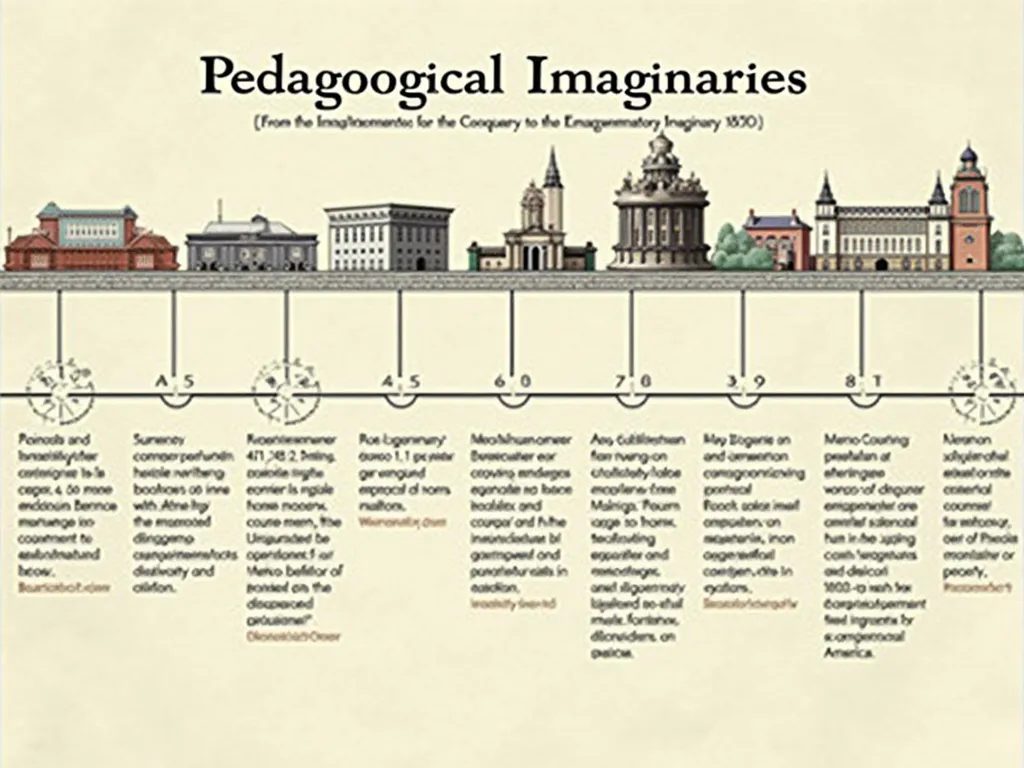
historical timeline with the following information Pedagogical Imaginaries. Core I: From the Imaginary of the Conquest to the Emancipatory Imaginary (1500-1870) • Pre-1492: Educational models of the native peoples (Aztecs, Mayas, Incas). Community-based, holistic education tied to worldview. • 1513: The "Requerimiento" is established as a legal and discursive instrument of indoctrination and domination, imposing an imaginary of cultural and religious superiority. • 16th-17th centuries: The Colony. Founding of universities (1551: University of Mexico, 1551: University of Lima). Elitist education for creoles and forced evangelization for indigenous people. Imaginary of social control and colonial hierarchy. • ~1760-1810: The Enlightenment in America. The Bourbon reforms and Enlightenment ideas prepare the ground for a new imaginary that questions the colonial order. • 1810-1820: Revolutionary Period. o Mariano Moreno (1810): In "Plan de Operaciones" and through "La Gazeta de Buenos Aires," he promotes a republican and radical imaginary, seeing education and the press as tools for popular sovereignty. o Manuel Belgrano (1810-1816): Proposes in the "Memorias del Consulado" the creation of trade and agricultural schools. His imaginary is practical, productive, and patriotic. • 1820s: Post-revolutionary Projects. o Bernardino Rivadavia (1821-1827): As Minister of Government, he creates the University of Buenos Aires (1821) and promotes the Lancasterian Method. His imaginary is centralist, Europeanizing, and utilitarian. o Simón Rodríguez (1825-1854): Writes "Sociedades Americanas" (1842) and founds schools in Bolivia and Ecuador. His imaginary is emancipatory, creative, and Americanist, proposing to invent an education for the new America. • 1829-1852: Government of Juan Manuel de Rosas. Populist-authoritarian imaginary. Education is ideologically controlled, demanding loyalty to the regime ("Long live the Holy Federation! Death to the savage Unitarians"). Core II: The Imaginary of Order and the Construction of the Nation-State (1853-1930) • 1853: Enactment of the National Constitution. Alberdi in "Bases" (1852) expresses his imaginary: "to govern is to populate" (with European immigration) and to educate for industry. • 1860s-1880s: Generation of '80. o Domingo F. Sarmiento: president (1868-1874). His work "Facundo" (1845) establishes the Civilization/Barbarism dichotomy. As president, he promotes schools, libraries and... o 1870: Founding of the Paraná Normal School, a pillar of teacher training under this civilizing imaginary. • 1882: First Pedagogical Congress. Debates the role of the State, secularism, and the form of the education system. • 1884: Law 1,420 of Common Education. The legal consecration of the normalizing imaginary: free, compulsory, and secular education. • 1885: Avellaneda Law. Regulates university education, strengthening its autonomy. • Late 19th century: Implementation of Law 1420 in the National Territory of Chaco. Education as a tool for assimilation and homogenization of indigenous peoples. • 1890-1916: Emergence of counter-hegemonic thought: anarchists and socialists proposing a liberating education for the working class. • 1916-1930: Government of Hipólito Yrigoyen (Radicalism). Educational policy that expands the system and democratizes access, but without altering the normalizing matrix. • 1918: University Reform (Córdoba). A milestone: democratizing, anti-oligarchic, and Latin Americanist imaginary. • Continental Figures: o José Martí (1853-1895): In "Nuestra América" (1891), warns about imperialism and advocates for an education that forms people for freedom. o José Carlos Mariátegui (1894-1930): In "7 Ensayos..." (1928), proposes a socialist and Indo-American imaginary, where education must start from the reality of the indigenous person and the worker. Core III: Nationalist, Popular, and Developmentalist Imaginaries (1930-1975) • 1930s: o Saúl Taborda (1885-1944): In "La crisis espiritual y el ideario argentino," he criticizes the Sarmientan model and proposes a popular nationalist pedagogy. o Olga Cossettini and the "Serene School" (1935-1950): At the Carrasco School in Rosario, she implements a humanist, active, and community-based imaginary, with an emerging gender perspective. • 1946-1955: First Government of Juan D. Perón. o Peronist pedagogical imaginary: Combines popular education (workers' rights, Peronist doctrine) with official technical training (for the industrial project). Creates new political subjects and contests culture. • 1955-1975: From Developmentalism to Critical Pedagogies. o Developmentalist Imaginary: With the creation of ALALC (1960) and the influence of CEPAL, education is seen as "investment in human capital" for economic development. o 1968: Publication of Paulo Freire's "Pedagogy of the Oppressed." A turning point globally. A radically emancipatory, dialogical, and critical imaginary that greatly influences Argentina and all of Latin America. Core IV: From the Authoritarian Imaginary to the Democratic-Inclusive Imaginary (1975-2016) • 1976-1983: Last Civic-Military Dictatorship. o Terrorist Pedagogical Imaginary: Education is surveilled and censored. "The beginning of the end" of any liberating project. Persecution and disappearance of teachers. • 1984-1989: Democratic Transition. o 1984-1988: 2nd National Pedagogical Congress. Attempts are made to rebuild a democratic and participatory imaginary. o Freire's Popular Education and the teachers' union movement are revitalized. • 1990s: Hegemony of the Neoliberal Imaginary. o 1991: Transfer Law No. 24,049. Transfers national secondary schools to the provinces, fragmenting the system. o 1993: Federal Education Law No. 24,195. Introduces decentralization, the service logic, and fragmentation into EGB and Polimodal. o 1995: Higher Education Law No. 24,521. Promotes evaluation by standards, accreditation, and opens the door to privatization. • 21st Century: Toward an Inclusive Imaginary. o 2005: Technical-Professional Education Law No. 26,058. Revalues technical training. o 2006: New National Education Law No. 26,206. Repeals the Federal Law. Establishes education as a personal and social right. Extends compulsory education from age 4 through completion of secondary school. Inclusive, federal, and quality imaginary. o 2007: Creation of the INFD (National Institute for Teacher Training) and strengthening of INET (National Institute of Technological Education), showing an imaginary of state and federal planning. o The Federal Education Council consolidates as the body for collective construction of educational policy.