




Perpetual Waterfall
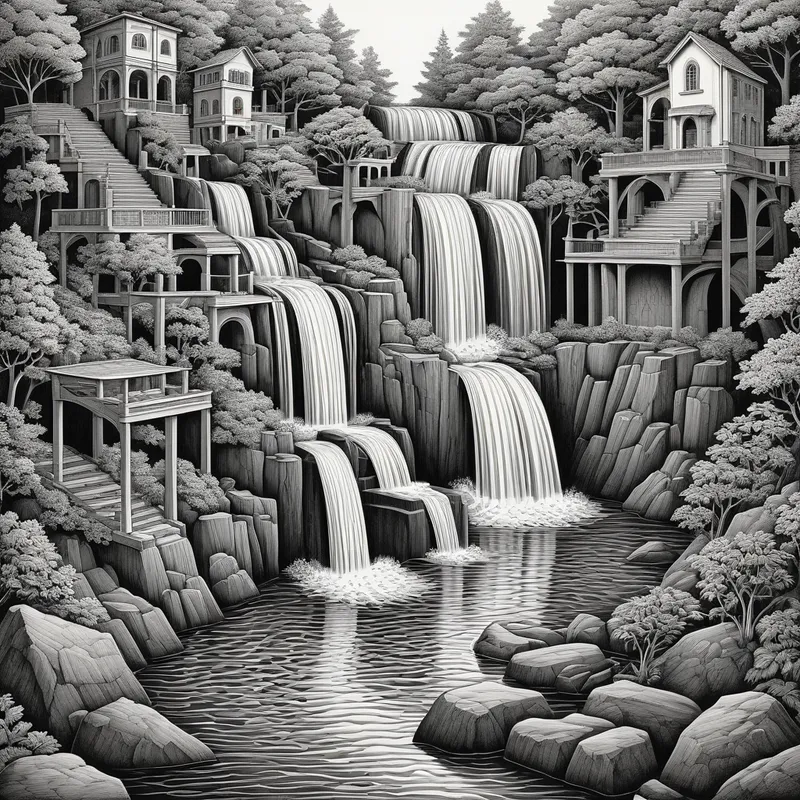
Create a highly detailed and precise drawing inspired by M.C. Escher's "Waterfall". The drawing should depict an impossible waterfall, where water appears to flow uphill in a continuous loop, creating an optical illusion. The waterfall starts at the top of a series of terraces and flows down through a series of channels and aqueducts, only to return to the top in an impossible, perpetual motion. Elements to include: Structure and Flow: The waterfall should begin at the top of a high tower. Water flows downward in a zigzag pattern through a series of channels and terraces. Ensure the water appears to defy gravity, flowing back up to the top of the structure. Supporting Architecture: Incorporate ancient, fortress-like towers and columns supporting the aqueducts. The towers should have a medieval or ancient architectural style. Add details like arches, windows, and brickwork for realism. Background: Place the structure in a surreal, otherworldly landscape. Include distant mountains or cliffs to enhance the illusion. Use a sky with an unusual color gradient to add a dreamlike quality. Additional Illusions: Integrate elements like staircases that loop back on themselves, creating further visual paradoxes. Include people or creatures interacting with the structure, emphasizing the scale and impossibility. Lighting and Shadows: Use realistic lighting and shadows to enhance the three-dimensionality of the drawing. Ensure the light source is consistent and adds to the overall illusion of the structure. Perspective: Utilize multiple vanishing points to create the optical illusion. Ensure the perspective lines lead the viewer's eye in a continuous loop, emphasizing the impossible nature of the waterfall. The drawing should be technically and geometrically accurate, capturing the essence of Escher's style while presenting a new, unique take on the impossible waterfall illusion.